

Environmental degradation, including climate change, is a human rights crisis
Access to water and sanitation, as well as a clean, healthy and sustainable environment, are human rights that are clearly defined in United Nations resolutions. Consequently, environmental and climate protection measures cannot be pursued in isolation from ensuring respect for human rights; rather, environmental and climate protection measures must be based on a human rights-based approach. This is in the focus of the recently published policy brief by UN-Water.
As environmental degradation and climate change have profound consequences for access to safe drinking water, sanitation and a healthy environment, they substantially affect human rights. In 2025, the International Court of Justice emphasized the strong relation between human rights, climate law and environmental agreements. Therefore states and other actors are called to systematically obey to human rights standards in actions across water, sanitation, climate, biodiversity, land, and disaster riskframeworks, policies, plans and strategies.
Environmental damage affects vulnerable groups more severely
The brief emphasizes that environmental harms do not fall evenly across societies but exerbate pre-existing inequalities and structural discrimination. The list of groups exposed to overlapping risks is long:
Women and girls, children and youth, indigenous peoples, minorities, people of African descent, peasants and small‑scale fishers, people on the move, persons living in poverty or informal settlements, persons with disabilities, older persons, LGBTIQ+ persons, prisoners and detainees, workers (especially in heat‑exposed and informal sectors), and environmental human rights defenders.
Policies and plans must be designed to identify, assess, prevent and remedy discrimination, ensuring that no one is left behind.
Main principles of the human rights based approach (HRBA)
Respecting human rights in policies demands for information, participation and access to justice for all.
Meaningful participation is needed across different levels of governance planning, investment, monitoring, evaluation, reporting, technology transfer and financing. The states’ dutyis comprise collecting and proactively disseminating environmental and WASH data, address the digital divide, ensure meaningful public participation (including FPIC for Indigenous Peoples), conduct integrated environmental and human rights impact assessments, and provide effective remedies for rights violations.
It also calls for coherent national frameworks that embed human rights in climate instruments (NDCs, NAPs), biodiversity strategies (KMGBF), and other sectoral plans, breaking down policy silos between water, sanitation, climate, biodiversity, and development agendas.
Furthermore, states must prevent and adress business-related human rights abuses as well as businesses have a corporate responsibility to respect human rights and provide remedies.
Current and emerging threats
The brief identifies emerging threats and policy gaps, such as environmental harms in conflict settings and the rapidly growing water and energy demands of data centres. These mean additional risks for undermining rights if not regulated through a HRBA.
Examples for good practices implemented so far
The report not only calls for a human rights-based approach to environmental and water projects, but also provides examples of initiatives that have already been successful:
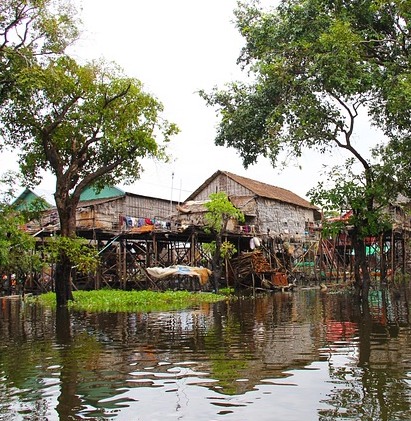
- Human rights-based approach to ecosystem protection, biodiversity conservation, and community resilience in the Tonlé Sap Lake region in Cambodia….(see featured image),
- reclaiming water rights through people’s science and storytelling in the Sahel,
- human rights-based water tariff reform to protect low-income households in Costa Rica,
- human rights-based WASH amid climate change and displacement in Yemen.
Featured Image. Kompong Phluk Tour Village, from the biosphere reserve Tonlè Sap in Kambodscha, Souce: Sharon Ang / Pixabay