



Most industrial countries face major challenges with respect to meat rising demands for electric energy with production technologies that are safe, clean, climate friendly and affordable. The German government decided to booster science and technology development for using fusion reactors to produce electric energy.
In October 2025, the Federal government published their Action Plan „Deutschland auf dem Weg zum Fusionskraftwerk” (Germany on the way to the fusion power plant). This document that was elaborated and published by the Federal Ministry for Research, Technoloy and Space (BMFTR), contents eight fields of action and measures. These shall facilitate building the first demonstrator of a fusion power plant:
- Strengthening research funding,
- Building a fusion ecosystem (from science and industry),
- Research infrastructure and technology demonstrators,
- Education and training of experts,
- Involving the public,
- Regulation in the frame of the Radiation Protection Act,
- Protektion of intellectual properties and standardization,
- Strategic and international cooperations.
The funding project called „Fusion 2040“ is planned to be supported with 1.7 billion Euro. In total, about 2 billion Euro will be spent for research funding as well as the building of research infrastructures and technology demonstrators by 2029.
Energy generation by nuclear fusion
Nuclear fusion is a chemical reaction that happens in the interior of stars like our sun: atomic nuclei, protons, merge to one nucleus with less weight than the sum of the weights of the single starting nuclei. The mass difference is set free as energy detectable as light and heat of the stars. The conditions of nuclear fusion reaction are described on the website of the International Atomic Energy Agency IAEA, among others.
Research activities to make use of nuclear fusion have been going on since the 1950s. But the extrem temperature and pressure conditions that are necessary to initiate the fusion reaction are a great challenge to be overcome for a technical implementation. This is why the fusion power plant has not been built so far. Inside the sun protons exist in the form of plasma with more than 100 million degrees Celcius. Under these conditions nuclei and electrons are completely separated from each other.
To enable the fusion in a controlled technical environment this kind of plasma must be generated by supplying energy to the system. To achieve an energy-positive process, the nuclear fusion must take place as an energetic chain reaction: The energy emitted by the first reaction steps is used to enable the fusion of further nuclei.
The most favourable raw material with respect to the reaction probability and the energy recovery is a mixture of tritium and deuterium:
T + D → He + n + 17,6 MeV
The most promising technical solutions
The different reactor types realized as research reactors so far differ from each other by the way to stabilize the plasma over a certain period of time. This is necessary to enable the reaction of newly inserted fusion fuel to keep the chain reaction going on. The most important reactor technologies are magnetic fusion and laserfusion (also referred to as inertial confinement fusion).
With magnetic fusion the plasma is stabilized by extremely strong magnetic fields, which prevent the plasma from touching the reactor walls, were it would cool down. The most important types of magnetic fusion reactors are the Tokamak type and the Stellarator type. The world’s largest Tokamak reactor is being built in the ITER project in South France (see picture). In this reactor type the plasma is stabilized by an internal electric current.
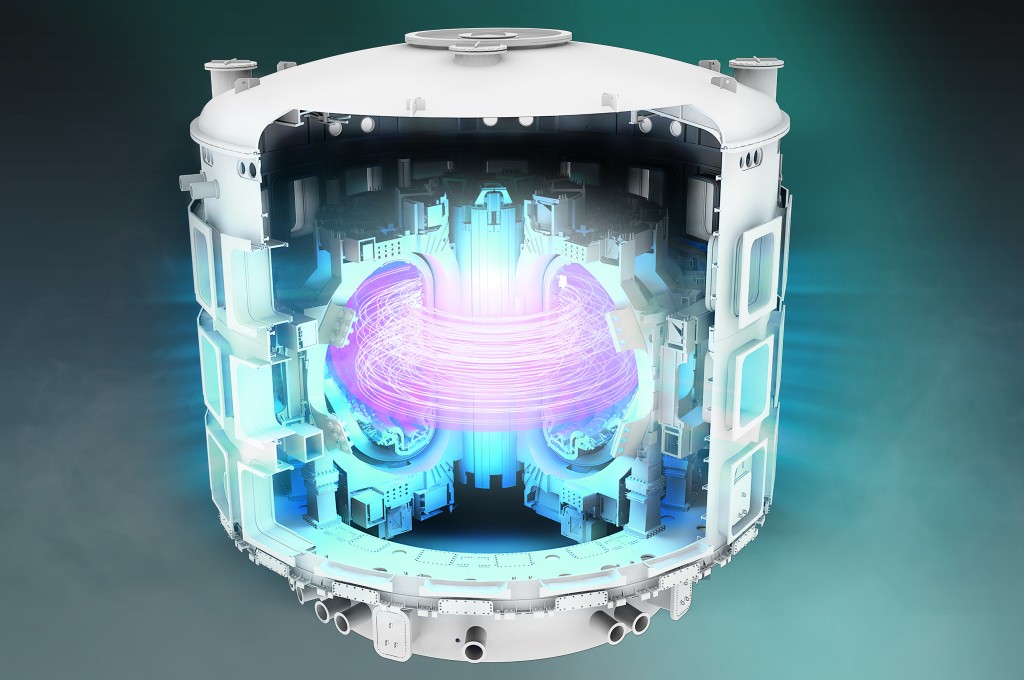
The largest Tokamak reactor worldwide is being built as part of the Mega project ITER in southern France. It will contain a plasma volume of 840
The world’s largest research reactor of the Stellarator type is called Wendelstein 7-X and is located at the Max Planck Institute für Plasma Physics in Greifswald, Germany. This reactor contains complex-shaped magnetic coils that keep the plasma on track without the need to generate an electric current [1].
Laser fusion is currently considered the most important alternative to magnetic fusion. In this process, a target made of fusion fuel is exposed to extreme temperatures and pressures generated by laser radiation. The heating and compression must proceed extremely quickly so that a sufficient number of fusion reactions can take place. The “breakthrough” for this technology was achieved in December 2022 at the National Ignition Facility (NIF) in California (USA): Using 2.05 MJ of laser energy, NIF scientists were able to ignite a plasma that released 3.15 MJ of energy [2].
The action plan of the German federal government includes building up research infrastructures for laser fusion in Germany.
From energy-positive fusion to a commercial power plant
… a long distance must still be overcome. But we should start now, says Prof. Haefner, commissioner for fusion research of the Fraunhofer Gesellschaft in Germany, 2022:
“Fusion is a high-risk, high-return investment and – if successful – the holy grail for achieving energy sovereignty and meeting the world’s energy needs in the long term. Now is the time to set sail to bring fusion energy to the grid, a journey that is clearly a multidecadal effort, assuming the world will commit and sustain investment.”
Further references:
[1] M. Large: Die Ansätze der Kernfusion: Tokamak, Stellarator und Co.; https://www.all-electronics.de/elektronik-entwicklung/die-ansaetze-der-kernfusion-tokamak-stellarator-co/750079, abgerufen am 12. November 2025 [2] Press release by Fraunhofer Institute for Laser Technology ILT, Aachen, from 13 December 2022, assessed on 12 November 2025