






Alternatives to PFAS for functional textiles
Manufacturers of functional textiles, including protective and outdoor clothing, are among the main users of PFAS. In anticipation of the imminent implementation of far-reaching restrictions on PFAS by the European Commission, industry and research institutes have been working for some time on developing effective alternatives.
PFAS )(per- and polyfluorated alkyl substances) make functional clothing and technical textiles water-, dirt- and oil-repellent; they also impart high thermal and chemical resistance. According to estimates by the European Environment Agency (EEA), the textile industry accounts for around 35% of global demand for PFAS, with more than 75% of PFAS in textile products being used as polymers. These include, for example, climate membranes made from PTFE.
Water-repellent materials without PFAS
For sailing, cycling, hiking, trekking or ski clothing, the market already offers a range of functional clothing that does not contain PFAS; the same applies to bags. For instance, the well-known Teflon climate membrane is now being replaced by membranes made from expanded polyethylene, polyurethane or polyether/ester block copolymers.
Fluorine-free textile coatings consist of silicones, waxes or hydrocarbons; plant-based systems are now also being used.
Challenge: Protection against oils
However, no fluorine-free, high-performance products with oil-repellent properties are yet available. Yet in the recently concluded German IGF project ‘C6C8 turn green’, textile researchers at the STFI in Chemnitz and chemists at the Leibniz Institute for Polymer Research in Dresden have developed an environmentally friendly alternative to fluorocarbon finishes.
The oil-repellent effect of the fluorine-free textiles is achieved by combining two compounds: POSS (polyhedral oligomeric silsesquioxanes) and TRIS ([Tris(trimethylsiloxy)silyl]).
The researchers specifically synthesised copolymers from tert-butyl methacrylate (TBMA) and the methacrylate-functionalised compounds POSS (POS-SMA) and TRIS (TRISMA). Using mini-emulsion polymerisation, they then produced aqueous dispersions for textile finishing.
The textiles were treated in two stages: first, an adhesion-promoting polyamine layer was applied using cross-linker-containing, aqueous polyvinylamine or chitosan formulations. The textiles were then functionalised with the copolymer dispersion. Both layers were applied using the foulard process, then thermally dried and cross-linked.
Effectiveness tested after wash cycles
To test the effectiveness, the researchers examined the treated cotton fabrics before and after specified wash cycles. The samples were washed at 60 °C and then tumble-dried at 70 °C. Before washing, they achieved a contact angle of up to 129° with water. After five wash and dry cycles, this was still 112°. The repellent effect was also maintained against ethylene glycol: the contact angle was up to 123° before washing and still 106° afterwards. This demonstrated an oil-repellent effect, meaning that textile manufacturers now have a high-performance alternative to fluorocarbon finishes at their disposal.
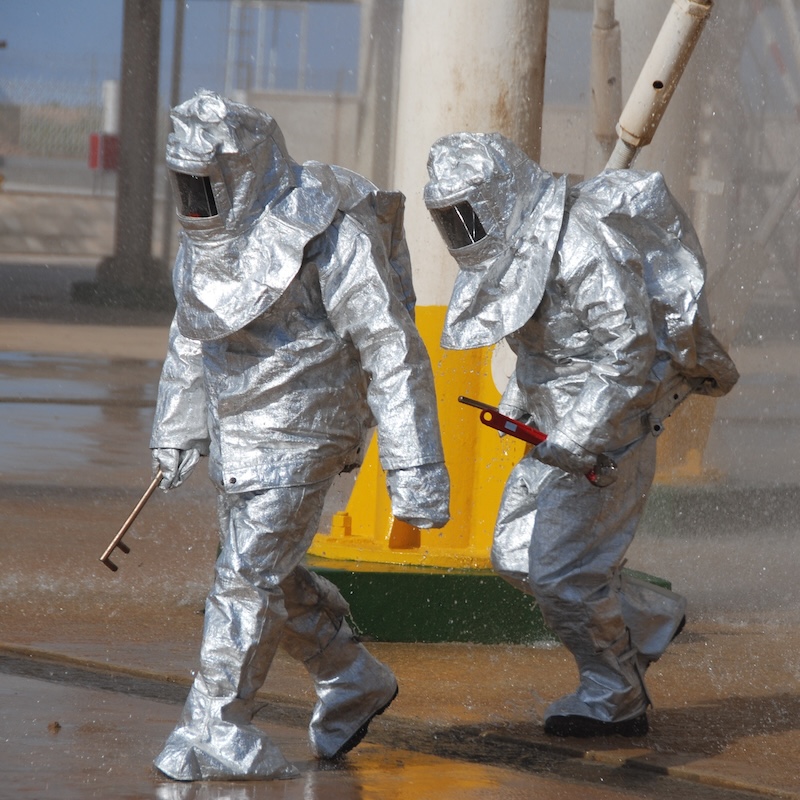
Featured image: Protective clothing for oil workers, by belief 33 / Pixabay